
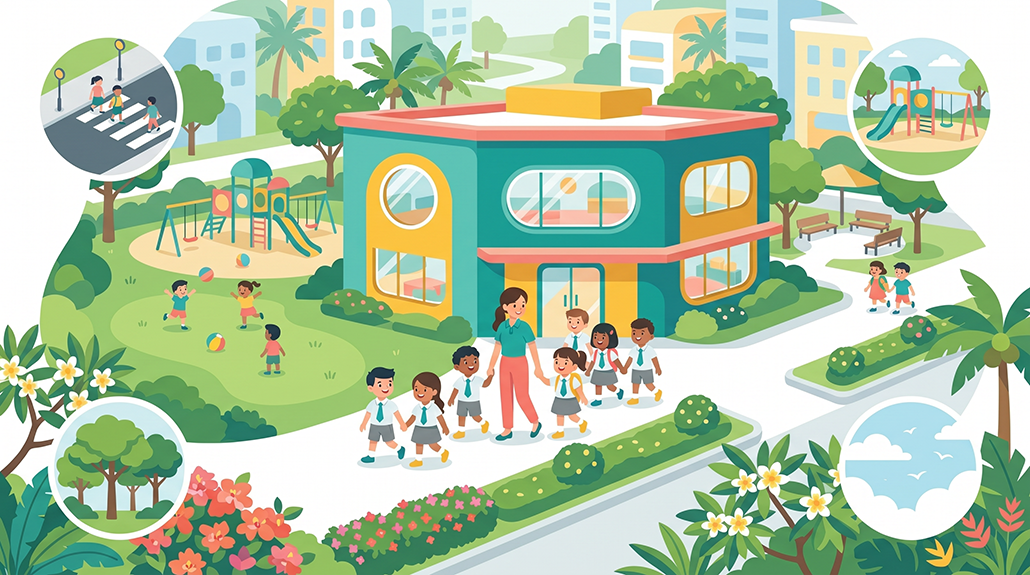
Why Location Matters: How Your Neighbourhood Shapes Your Child’s Pre-school Experience
When parents start searching for the right pre-school in Singapore, the checklist often begins with curriculum, fees, and school reputation. Location tends to get treated as a logistical afterthought, something to sort out once everything else lines up. But here’s the thing: where your child spends their early learning years matters far more than most families initially realise.
The neighbourhood surrounding a pre-school shapes the daily rhythm of your child’s life. It influences how rested and ready they arrive each morning, the kinds of experiences they’re exposed to beyond the classroom walls, and the sense of community that forms around their earliest friendships. For children between 18 months and six years old, a period that educational researchers widely regard as the most critical window for cognitive, social, and emotional development, environment carries enormous weight.
This article explores why location deserves a much closer look in your pre-school search, what to pay attention to in the surrounding neighbourhood, and how the right combination of place and pedagogy can give your child a genuinely enriching start.
Why Location Is More Than Just Convenience
It’s tempting to think of pre-school location purely in practical terms. Is it near the MRT? Is it on the way to work? These are reasonable questions, but they only scratch the surface. Location shapes a child’s pre-school experience in ways that go well beyond the school gate. The broader neighbourhood, the surrounding environment, and the community your family becomes part of all play a quiet but meaningful role in how your child grows and learns during these formative years.
Research in early childhood development consistently shows that children are highly sensitive to their environments. They pick up on the energy, pace, and character of the spaces they inhabit regularly. A pre-school situated in a calm, green, and community-oriented area tends to support lower stress levels and greater readiness to engage with learning. By contrast, a high-traffic, congested, or chaotic surrounding can subtly contribute to overstimulation, particularly in toddlers and young pre-schoolers who are still developing their ability to self-regulate.
Thinking about location as part of the educational experience, rather than separate from it, gives parents a more complete picture of what daily life at a particular pre-school will actually feel like for their child.
The Daily Commute: How Travel Time Affects Young Children
Young children thrive on consistency and rest. Long or stressful commutes eat into both. A pre-schooler who travels 45 minutes to an hour each way is spending a significant portion of their energy reserves before they’ve even set foot in the classroom. By the time they arrive, they may already be tired, overstimulated, or hungry, none of which sets the stage for curious, engaged learning.
A pre-school that’s reasonably close to home also makes it easier to maintain the kind of stable daily routines that young children depend on. Drop-off and pick-up become less rushed, there’s more flexibility if your child is having a slow morning, and the transition between home and school feels gentler and more manageable. Over weeks and months, these small advantages add up considerably.
There’s also the emotional dimension to consider. Young children often need a familiar, reassuring environment to help them settle confidently into school life. When home and school are part of the same neighbourhood fabric, when your child recognises the coffee shop downstairs or the park around the corner, that continuity can provide a real sense of security during the adjustment period.
The Neighbourhood Environment and What It Teaches
Children are natural observers. They absorb what they see, hear, and experience in their surroundings with remarkable depth. The neighbourhood around a pre-school is, in a very real sense, an extension of the learning environment. A school nestled near a park offers spontaneous opportunities for nature-based exploration. One located near a library, a community garden, or a cultural landmark opens doors to incidental learning that no classroom worksheet can replicate.
Even the walkability and green cover of a neighbourhood contribute to early development. Studies have found that access to natural outdoor spaces supports better concentration, lower anxiety levels, and stronger imaginative play in young children. When a pre-school’s outdoor activities can spill naturally into the surrounding environment, even occasionally, the richness of early learning expands considerably.
Safety is another dimension of neighbourhood environment that parents rightly prioritise. Well-maintained footpaths, manageable traffic, and a general sense of community watchfulness all contribute to a safer arrival and departure experience, particularly for families who walk or cycle with young children.
Community Connections: Building a Sense of Belonging
One of the less visible but deeply important benefits of choosing a pre-school in your own neighbourhood, or one that functions as a genuine community hub, is the social web it creates for your family. When your child’s classmates live nearby, friendships form more naturally and carry beyond school hours. Weekend playdates, chance encounters at the void deck or playground, and shared community events all reinforce the bonds that begin in the classroom.
For parents, being part of a neighbourhood pre-school community offers its own form of support. Getting to know other families who share similar values and routines can be enormously reassuring during the early years of parenting. It builds the kind of informal network where parents exchange advice, share resources, and look out for one another, something that’s genuinely hard to replicate when children are scattered across distant parts of the city.
A pre-school that is embedded in its local community also tends to develop a stronger sense of identity and purpose. Staff get to know families over time, children grow up alongside familiar faces, and the school becomes a trusted anchor point in neighbourhood life. This sense of rootedness matters deeply to young children, whose emotional security is closely tied to familiar relationships and places.
Nearby Facilities and Learning Opportunities
A pre-school’s physical premises tell only part of the story. What surrounds it matters too. Proximity to libraries, community centres, nature trails, cultural spaces, and even well-regarded hawker centres (for community-focused learning walks) can meaningfully enrich the experiential curriculum a school is able to offer.
The best early childhood educators know that learning doesn’t stop at the classroom door. Field trips to nearby locations, spontaneous weather observations in an accessible outdoor space, and walks through a characterful neighbourhood all build vocabulary, curiosity, and a child’s understanding of the wider world. A school that can leverage its surroundings thoughtfully is one that’s making the most of every learning moment available to it.
This is worth asking about during a school visit. Does the pre-school make use of nearby facilities as part of its regular programme? Are there planned outdoor activities that take children into the surrounding area? How does the school think about the neighbourhood as part of the learning environment? The answers reveal a great deal about the school’s educational philosophy and ambition.
How the Right Pre-school Pairs Location with Curriculum
Location becomes most powerful when it is matched with a curriculum that is equally thoughtful. A beautifully situated pre-school with a weak educational programme is a missed opportunity. Equally, a brilliant curriculum delivered in an inaccessible or unsuitable environment creates unnecessary friction in your child’s daily life. The goal is to find both together.
At ChildFirst, both of our centres in Singapore, Hillview and Tampines, have been carefully chosen to serve the families in those communities, with spaces designed to support our unique educational approach. Our curriculum brings together three interconnected strands of learning: an Artificial Intelligence curriculum that introduces children to the tools shaping their future, a Human Intelligence curriculum that nurtures creativity, empathy, and critical thinking, and a Multiple Intelligences curriculum that honours the fact that every child has their own unique strengths and ways of learning.
This trilingual approach extends to language as well. Our children develop genuine proficiency across English, Mandarin, and coding as the third language, supported by rich English language learning, dedicated Chinese pre-school learning, and coding as a core part of the trilingual framework, preparing children for a world where digital fluency and multilingualism go hand in hand. When this level of curricular depth is delivered within a well-chosen, community-rooted location, the result is an early childhood experience that genuinely sets children up for life.
What to Look For When Visiting a Pre-school Location
A school tour is your best opportunity to experience a location with fresh eyes. Go beyond the classrooms and look at the broader setting with your child’s daily experience in mind. Here are some practical things worth paying attention to:
- Ease of access: Is the route from home manageable without excessive travel time? Are there safe pedestrian crossings and transport links nearby?
- Green spaces: Is there a park, open field, or landscaped area within easy reach that the school uses as part of its programme?
- Safety and traffic: How busy is the road outside during drop-off and pick-up hours? Is there sufficient space for a smooth, safe transition?
- Community feel: Does the surrounding area feel like a place where families are present and active? Is there a sense of neighbourhood life beyond the school gates?
- Facilities nearby: Are there libraries, community spaces, or cultural venues that the school might draw on for learning excursions?
- School environment itself: Are the classrooms well-ventilated, bright, and thoughtfully set up? Does the physical space reflect the school’s educational values?
Trust your instincts here too. Parents often have a strong sense, after walking through a neighbourhood and a school, of whether it feels right for their child. That intuition is worth taking seriously, it’s usually picking up on something real.
Putting It All Together
Choosing a pre-school is one of the most important decisions you’ll make for your child in their early years. The curriculum, the teachers, and the school’s values all matter deeply, but so does where that school sits in the world. The neighbourhood surrounding your child’s pre-school shapes their daily experience in ways both visible and invisible, from how rested they arrive each morning to the community of families they grow up alongside.
The good news is that you don’t have to choose between a great curriculum and a great location. The right pre-school brings both together with care and intention. When you visit, look at the whole picture: the streets outside, the feel of the community, the spaces your child will move through every single day. That’s where the full story of your child’s pre-school experience really begins.
Come and See Our Centres for Yourself
Both ChildFirst centres have been thoughtfully located and designed to give your child the best possible start. Experience our award-winning trilingual curriculum, our state-of-the-art facilities, and the warm community that makes ChildFirst a place children love to come to every day.