What Is Play-Based Learning and Why Do Singapore Pre-schools Use It?
If you have ever watched a young child completely absorbed in building a block tower, narrating an elaborate story with toy figures, or mixing colours with paint-covered fingers, you have witnessed something far more significant than simple fun. You have seen a child’s brain at work. Play-based learning is the approach that harnesses this natural energy and curiosity, turning everyday play into one of the most powerful engines for child development we know of.
For parents in Singapore navigating the many pre-school options available, the term “play-based learning” comes up often, but what does it actually mean in practice? Why have so many Singapore pre-schools, including award-winning institutions, built their entire curriculum philosophy around it? And most importantly, is it really the best preparation for your child’s future? This article answers all those questions, exploring the science, the practice, and what to look for in a pre-school that gets it right.
What Is Play-Based Learning?
Play-based learning is an educational approach that uses play as the primary vehicle through which children explore, discover, and make sense of the world around them. Rather than having children sit and receive information passively, play-based learning invites them to be active participants, building, creating, pretending, experimenting, and problem-solving in ways that feel entirely natural to them. It is grounded in decades of research from developmental psychologists, most notably Jean Piaget and Lev Vygotsky, both of whom identified play as central to how children construct knowledge and develop language, reasoning, and social understanding.
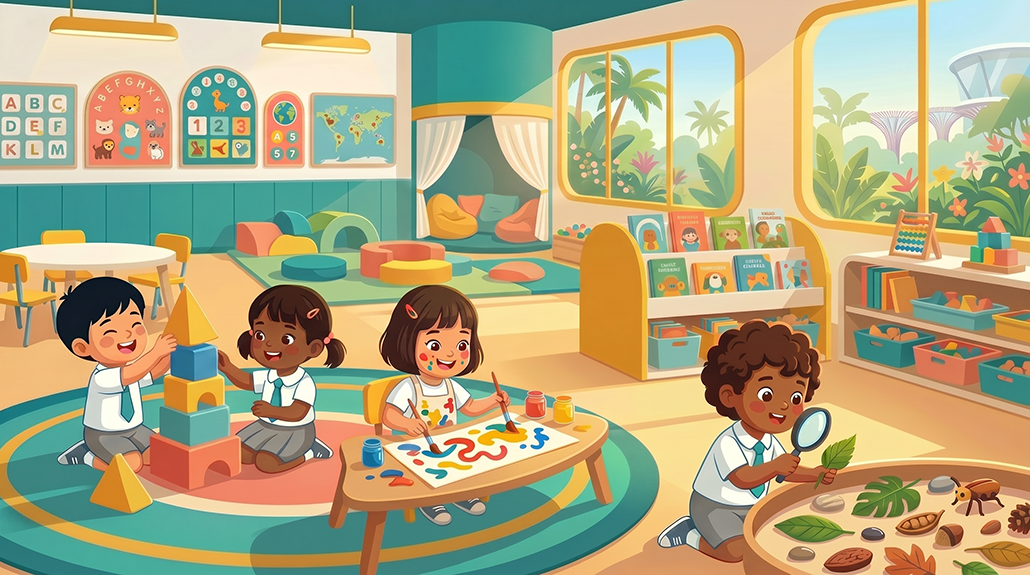
It is worth noting that play-based learning is not the same as unstructured free time, though free play does play a valuable role within it. In a well-designed pre-school programme, educators thoughtfully plan the environment, materials, and activities so that specific learning goals are woven into the play experience. A child sorting coloured blocks by shape is developing early mathematical thinking. A group of pre-schoolers negotiating the rules of a pretend restaurant are practising communication, cooperation, and even early literacy. The learning is real, it simply does not look like a traditional classroom lesson.
The Different Types of Play in Early Childhood
Not all play is the same, and understanding the variety helps parents appreciate just how rich and layered a play-based curriculum can be. Educators typically recognise several distinct forms of play, each contributing differently to a child’s growth:
- Dramatic or pretend play. Children take on roles, create imaginary scenarios, and develop narrative thinking and empathy by stepping into someone else’s shoes.
- Constructive play. Building with blocks, Lego, clay, or recycled materials develops spatial reasoning, engineering thinking, and fine motor skills.
- Physical or outdoor play. Running, climbing, and balancing activities build gross motor skills, body awareness, and resilience through manageable physical challenges.
- Games with rules. Board games, simple card games, and group activities teach turn-taking, fairness, strategic thinking, and emotional regulation when things do not go to plan.
- Exploratory or sensory play. Water play, sand trays, and mixing materials engage children’s senses and encourage scientific curiosity and inquiry.
A quality pre-school programme incorporates all of these play types throughout the day, ensuring children are stretched across multiple areas of development, not just one or two.
Why Do Singapore Pre-schools Use Play-Based Learning?
Singapore’s Ministry of Education (MOE) and the Early Childhood Development Agency (ECDA) have both identified play as a cornerstone of effective early childhood education. The Nurturing Early Learners (NEL) framework, which guides curriculum development for Singapore pre-schools, explicitly places learning through play at its heart. This is not simply a fashionable trend, it is a policy position grounded in research showing that children aged 18 months to six years learn most effectively when they are engaged, motivated, and emotionally safe, all conditions that good play naturally creates.
There is also a broader, forward-looking reason. Singapore’s education system has long been respected internationally for its rigour, but there is growing recognition that the skills children will need in an AI-driven, rapidly changing world go well beyond rote knowledge. Skills like creativity, collaboration, adaptability, and critical thinking are deeply nurtured through play in the early years. Pre-schools in Singapore that invest seriously in play-based learning are not just following guidelines, they are making a considered investment in children’s long-term capability and wellbeing.
Key Benefits of Play-Based Learning for Young Children
The body of research supporting play-based learning is substantial, and the benefits span virtually every domain of early childhood development. Here is what the evidence consistently shows:
Cognitive Development
When children play, they are constantly problem-solving. A child trying to balance an uneven block tower is experiencing cause and effect. A child figuring out how much “pretend money” to give for their toy ice cream is developing number sense. These self-directed, motivated moments of thinking build cognitive flexibility and early academic foundations far more durably than drill-based instruction at this age.
Language and Literacy
Play is extraordinarily rich in language. Children narrate, negotiate, explain, question, and argue during play in ways that extend vocabulary and develop conversational fluency naturally. In a multilingual environment like Singapore, play provides an authentic context for children to hear and use different languages without the pressure of formal assessment. This is particularly valuable for trilingual programmes, where immersion through play helps children acquire languages in a meaningful, low-anxiety setting. You can read more about how this works in our approach to nurturing English proficiency in a trilingual environment and our approach to Chinese pre-school and trilingual learning.
Social and Emotional Development
Perhaps the most profound benefits of play-based learning lie in the social and emotional domain. When children play together, they learn to share, take turns, resolve conflicts, manage frustration, and celebrate each other’s successes. These are the building blocks of emotional intelligence, skills that researchers like Daniel Goleman have linked to long-term success and wellbeing. A child who has had rich, supported social play experiences in their pre-school years carries those interpersonal skills into primary school and beyond.
Creativity and Imagination
Open-ended play, where there is no single correct answer or outcome, is the ideal training ground for creative thinking. When a child transforms a cardboard box into a rocket ship, they are exercising the same mental flexibility and divergent thinking that will serve them as innovators and problem-solvers in adulthood. In a world where artificial intelligence can handle routine and repetitive tasks, creative human thinking becomes all the more precious, and it starts with imaginative play in the earliest years.
Does Play-Based Learning Mean Less Academic Preparation?
This is one of the most common concerns parents raise, and it deserves a direct answer: no. A well-implemented play-based curriculum does not trade academic readiness for fun. Rather, it builds academic foundations in a way that is developmentally appropriate and deeply effective. Research consistently shows that children who experience high-quality play-based early education demonstrate stronger literacy, numeracy, and executive function skills when they enter primary school, often outperforming peers who attended more formal, drill-based pre-schools.
The key word here is quality. Play-based learning works best when it is intentionally designed by trained educators who understand child development, who observe children carefully, and who know how to extend and enrich play experiences to maximise learning. It is not about leaving children to their own devices and hoping for the best. It is about creating the right conditions, asking the right questions, and providing just the right level of challenge to keep each child growing. When this is done well, combined with purposeful technology integration and multilingual exposure, the results can be remarkable. Our coding meets trilingual learning programme is one example of how structured play-based experiences can introduce even quite complex concepts to young children in ways that feel exciting rather than daunting.
How ChildFirst Brings Play-Based Learning to Life
At ChildFirst, play-based learning is not a standalone methodology, it is the thread that runs through every aspect of our unique three-pronged curriculum. Our approach combines Artificial Intelligence (AI) literacy, Human Intelligence (HI) development, and Multiple Intelligences (MI) nurturing, and each of these strands is brought to life through purposeful, engaging play.
Our Ednoland curriculum technology and EdnoAI applications create immersive, playful learning environments where children encounter coding concepts, storytelling, music, movement, and problem-solving as part of a seamlessly integrated daily experience. Rather than treating academic skills and play as separate activities, we design every moment with intention, so that a child building a structure in the play corner might be developing spatial intelligence, collaborating in Mandarin with a classmate, and exploring basic engineering principles all at once. This holistic approach reflects Howard Gardner’s theory of Multiple Intelligences, recognising that every child has a unique profile of strengths and that great early education meets children where they are.
Our SPARK-certified centres in Singapore, Hillview and Tampines, are designed with play-based learning in mind, featuring state-of-the-art facilities that invite curiosity and hands-on exploration at every turn. We believe that the physical environment itself is a teacher, and we invest carefully in spaces that spark imagination while supporting the rich trilingual immersion our curriculum is built upon.
What Parents Can Do to Support Play-Based Learning at Home
The wonderful thing about play-based learning is that it does not stop at the school gate. Parents play a vital role in extending and enriching what children experience in pre-school, and it does not require any specialist knowledge or expensive materials. Here are some simple, effective ways to support your child’s learning through play at home:
- Follow your child’s lead. Let them choose the game or activity and observe what interests them. Children learn most deeply when they are intrinsically motivated.
- Ask open-ended questions. Instead of “What colour is that?”, try “I wonder what would happen if we mixed those two colours together.” Questions that invite thinking are far more powerful than those with a single correct answer.
- Embrace mess and process. Resist the urge to tidy up during creative activities or to “fix” a child’s construction. The process of exploring and experimenting is where the learning happens.
- Read and tell stories together. Storytelling is a form of play, and it builds vocabulary, comprehension, and imagination simultaneously. Make it interactive by asking children to predict what happens next or to change the ending.
- Limit screen time for passive consumption. Not all screen time is equal. Interactive, creative digital experiences can support learning, but passive viewing limits the active engagement that play requires.
Small, consistent moments of playful engagement at home compound beautifully over time, reinforcing the foundations your child is building at pre-school and strengthening the parent-child bond in the process.
Play Is the Work of Childhood, and It Prepares Children for Life
The early years of a child’s life are a window of extraordinary opportunity. The brain is developing at a pace it will never match again, and the experiences children have during this time shape not just what they know but how they think, feel, and relate to others for years to come. Play-based learning respects this truth. It works with children’s natural drive to explore and discover, rather than against it, building the cognitive, social, emotional, and creative foundations that every child needs to thrive.
Singapore’s pre-schools have embraced this approach because the evidence for it is clear and compelling, and because parents, educators, and policymakers alike recognise that preparing children for the future means nurturing far more than academic knowledge alone. At ChildFirst, we take this responsibility seriously, combining the best of play-based pedagogy with future-ready curriculum innovation to give every child the richest possible start in life.
Want to See Play-Based Learning in Action?
Visit ChildFirst to experience our unique three-pronged curriculum, where play-based learning meets trilingual immersion, AI literacy, and Multiple Intelligences development, all designed to future-proof your child from the very earliest years.