
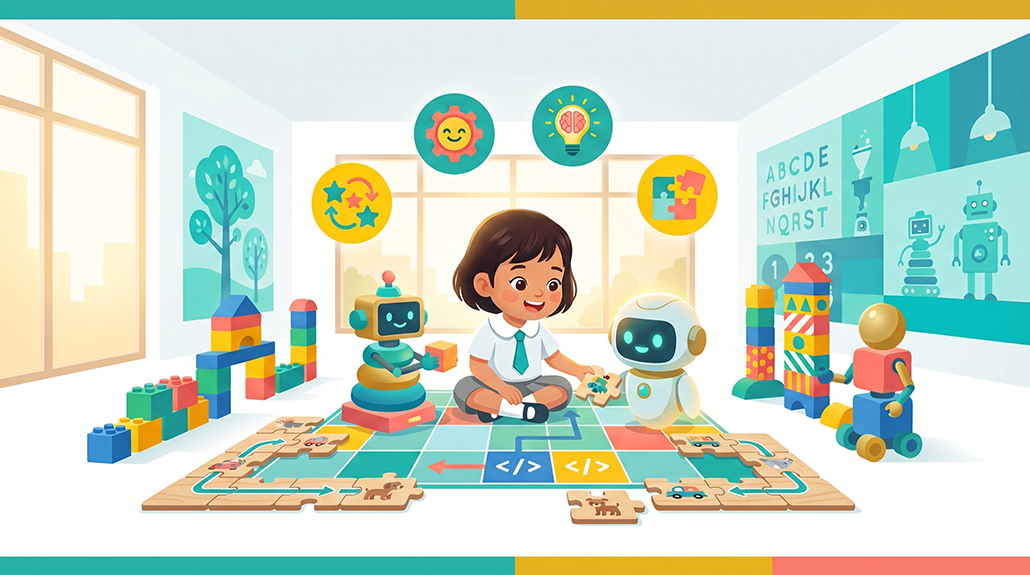
Computational Thinking for Pre-Schoolers: Building Problem-Solving Skills Early
Picture your three-year-old sorting their toy cars by colour, figuring out why a block tower keeps falling, or deciding which steps to follow when getting dressed in the morning. It might look like ordinary play, but these small moments are actually the earliest seeds of computational thinking for pre-schoolers. Long before a child touches a keyboard or meets a robot, they are already practising the core mental habits that underpin problem-solving, logical reasoning, and creative thinking.
Computational thinking is not about programming or screens. It is a way of approaching challenges: breaking big problems into smaller pieces, spotting patterns, and designing step-by-step solutions. And research consistently shows that the earlier children develop these habits of mind, the stronger their academic and life foundations become. In this article, we explore what computational thinking actually means for young children, why starting in the pre-school years matters so much, and how ChildFirst’s curriculum nurtures these skills in a way that feels joyful, natural, and age-appropriate.
What Is Computational Thinking, Really?
Computational thinking is a term coined in educational research to describe a set of problem-solving approaches that computers use, applied to human thinking. Dr. Jeannette Wing, who popularised the concept, described it as a way of “Solving problems, designing systems, and understanding human behaviour by drawing on concepts fundamental to computer science.” But do not let that description put you off. For young children, it simply means learning to think clearly, systematically, and creatively when faced with a challenge.
There is a common misconception that computational thinking is synonymous with coding or technology use. In reality, a child does not need a screen to practise it. When a pre-schooler organises their building blocks from tallest to shortest, they are using algorithmic thinking. When they notice that their playdough always cracks when it dries, they are spotting a pattern. These are genuinely computational ideas, expressed through the natural language of play.
Why Start Early? The Case for Pre-School Problem-Solving
The pre-school years, roughly from ages two to six, represent one of the most remarkable windows of neurological development in a child’s life. During this period, the brain forms synaptic connections at an extraordinary rate, and children are naturally predisposed to curiosity, experimentation, and trial-and-error learning. This makes early childhood the ideal time to introduce the habits of mind associated with computational thinking, not through formal instruction, but through well-designed play and exploration.
Studies in developmental psychology suggest that children who engage in structured problem-solving activities during the early years show stronger executive function skills, including working memory, cognitive flexibility, and inhibitory control, as they grow older. These are the very same skills that help children manage complex tasks, regulate their emotions, and persist through academic challenges. Starting early is not about rushing childhood; it is about making the most of a uniquely receptive season of growth.
Singapore’s educational landscape also reflects this understanding. With the nation’s ongoing focus on preparing young people for a technology-driven economy, Pre-schools that embed computational thinking into their early years programmes are giving children a meaningful head start, not just for STEM, but for life.
The Four Pillars of Computational Thinking in Early Childhood
Educators typically identify four core components of computational thinking. Understanding how each one appears in a pre-schooler’s world helps parents and teachers intentionally support its development.
- Decomposition: Breaking a complex task into smaller, manageable steps. For a pre-schooler, this might look like figuring out how to build a bridge with blocks by tackling one section at a time, rather than trying to do everything at once.
- Pattern Recognition: Noticing similarities, trends, and regularities. Children do this naturally when they predict what comes next in a story, identify repeated shapes in a mosaic, or realise that their toy car always rolls faster on a smooth surface than a rough one.
- Abstraction: Focusing on the key details of a problem and setting aside what is not relevant. A child choosing which costume pieces make them look “Like a superhero” is practising a form of abstraction by identifying the essential features and ignoring the rest.
- Algorithmic Thinking: Creating a sequence of steps to solve a problem or complete a task. Morning routines, recipes, and simple games all involve algorithms. When a child explains “First we put in the flour, then the eggs, then we stir,” they are describing an algorithm.
These four pillars are not isolated skills, they work together and reinforce each other. A rich early childhood environment invites children to use all four, often within a single activity or conversation.
Everyday Activities That Build Computational Thinking
One of the most reassuring things about computational thinking for pre-schoolers is that it does not require expensive tools or specialist equipment. Many of the best opportunities already exist in everyday play and routines. The key is for caregivers and educators to ask the right questions and create space for children to reason things through.
Consider the following examples of activities that naturally cultivate computational thinking skills:
- Sorting and classifying games: Grouping objects by colour, size, shape, or texture helps children practise decomposition and pattern recognition simultaneously.
- Simple board games and card games: Games with clear rules introduce children to sequential thinking and cause-and-effect reasoning in a low-pressure, enjoyable way.
- Storytelling and retelling: Asking a child to retell a story in order encourages algorithmic thinking: what happened first, next, and last.
- Building and construction play: Whether with blocks, magnetic tiles, or recycled materials, construction challenges prompt decomposition (“What do I need to build the wall first?”) and debugging (“Why did it fall? What should I change?”).
- Cooking and baking together: Following a recipe is one of the most intuitive introductions to algorithmic thinking that exists, and children love being involved.
The common thread in all these activities is that the child is actively thinking, making choices, and learning from outcomes. Adults play an important role by encouraging reflection: “What do you think happened?” and “What could we try differently?” are more powerful questions than simply providing the answer.
How an AI Curriculum Brings Computational Thinking to Life
At ChildFirst, computational thinking is not treated as a standalone lesson or a once-a-week activity. Instead, it is woven into the fabric of daily learning through the school’s innovative use of AI in their curriculum. This programme introduces children to the logic and language of AI, not by sitting them in front of a screen, but by engaging them in hands-on, inquiry-based experiences that develop the foundational thinking skills that AI literacy requires.
Children learn to ask questions like “Why did this happen?” and “What pattern do I see here?” in age-appropriate contexts. They explore how machines can be taught to recognise images or sort objects, and they begin to understand that the instructions we give computers matter enormously, just like the instructions we give ourselves when we try to solve a problem. This early exposure demystifies AI and positions children as confident, curious thinkers rather than passive consumers of technology.
Equally important is the way this curriculum connects with coding and trilingual learning at ChildFirst. Children explore computational concepts across all three languages of their education: English, Mandarin, and coding as the third language, which deepens their understanding and ensures that problem-solving becomes a cross-domain habit of mind, not a narrow technical skill.
Why Human Skills Matter Just as Much
Here is something worth pausing on: computational thinking is only one side of the equation. The world our children are growing into will be shaped by AI, yes, but it will still belong to humans. The skills that no machine can replicate, such as empathy, creativity, moral reasoning, collaboration, and emotional intelligence, are just as vital as algorithmic problem-solving. In fact, they are what give computational thinking its purpose and direction.
ChildFirst recognises this deeply. Alongside its AI curriculum, the school’s Human Intelligence curriculum nurtures the social-emotional and interpersonal skills that make children not just capable thinkers, but compassionate and resilient human beings. Children learn to communicate their ideas, navigate disagreements, show kindness, and persevere through difficulty. These are not soft extras, they are core competencies for a meaningful and successful life.
The school also draws on Howard Gardner’s theory of Multiple Intelligences to ensure that every child’s unique strengths are recognised and celebrated. Not every future innovator will think the same way, and ChildFirst’s Multiple Intelligences curriculum ensures that whether a child’s genius lies in music, movement, language, or logic, their learning environment speaks to their individual brilliance.
What Parents Can Do at Home
Parents are a child’s first and most influential teachers, and the home environment is full of natural opportunities to nurture computational thinking. You do not need to be tech-savvy or have any background in computer science. What matters is creating a culture of curiosity and reflection in your household.
Here are some simple, parent-friendly habits that make a genuine difference:
- Ask “how” and “why” questions often. Instead of telling your child how something works, invite them to wonder about it first. “Why do you think the ice melted?” is a more powerful learning prompt than simply explaining it.
- Celebrate mistakes as part of learning. When something does not work, treat it as useful information rather than a failure. “Interesting! That didn’t work, what could we try next?” models a problem-solving mindset.
- Give children manageable choices and challenges. Letting a child figure out how to pack their own bag or plan a simple activity builds the decomposition and sequential thinking skills they need.
- Read books that involve logic and sequences. Stories with cause-and-effect structures, patterns, or characters who solve problems are great conversation starters about thinking strategies.
- Play strategy games together. Even simple games like Snakes and Ladders, Uno, or memory matching cards build pattern recognition and rule-following in a warm, shared context.
The goal is not to turn playtime into a lesson. It is to gently reinforce the idea that thinking carefully and creatively is enjoyable, and that challenges are something to lean into, not shy away from.
Raising Future-Ready Thinkers
Computational thinking for pre-schoolers is not a trend or a luxury, it is a genuine foundation for lifelong learning. When young children practise breaking problems apart, spotting patterns, and thinking in sequences, they are building cognitive habits that will serve them across every subject, career, and life challenge they encounter. And when these skills are developed alongside empathy, creativity, and cultural fluency, children are truly prepared for a future we cannot yet fully predict.
At ChildFirst, this is not just an aspiration, it is the everyday reality of every classroom. Through a thoughtfully integrated trilingual curriculum that weaves together AI literacy, human intelligence, and an understanding of each child’s unique multiple intelligences, ChildFirst gives pre-schoolers in Singapore the richest possible start. The result is not just children who can think computationally, it is children who love to think, explore, and grow.
Want to See Computational Thinking in Action?
Visit ChildFirst to discover how our award-winning trilingual curriculum nurtures problem-solving, AI literacy, and irreplaceable human skills, all from the very first years of learning.