First Day of Pre-school in Singapore: How to Prepare Your Child (and Yourself)
The night before your child’s first day of pre-school, you might find yourself laying out their school bag, double-checking their water bottle, and feeling a surprising mix of excitement and anxiety, and that’s completely normal. For many Singapore families, enrolment in pre-school marks the very first time a child spends structured time away from home, and the emotions that come with it are real for both parent and child alike.
The good news is that with the right preparation, the first day of pre-school doesn’t have to be overwhelming. In fact, it can be the beginning of one of the most joyful chapters of your child’s early life. This guide walks you through practical, developmentally sound steps to help your little one settle in confidently, and to help you feel ready too.
Why the First Day of Pre-school Is Such a Big Deal
Starting pre-school is far more than just a logistical change to the family schedule. For young children, it represents their first real encounter with a world beyond the home: new adults to trust, new friends to make, new rules to follow, and new experiences to absorb. Research in early childhood development consistently shows that how children experience this transition can shape their attitude towards learning for years to come.
In Singapore, where the pre-school landscape is rich and varied, parents often feel additional pressure to choose the “right” school and ensure their child starts on the best possible footing. Understanding that a smooth transition is built gradually, not achieved in a single morning, is perhaps the most important mindset shift a parent can make.
Is Your Child Ready? Signs to Look Out For
Most children are developmentally ready to begin pre-school between the ages of 18 months and three years, though readiness looks different for every child. Rather than focusing on a specific age, look for a cluster of readiness signals that suggest your little one is prepared for group learning environments.
- Basic self-care skills: Can your child manage simple tasks like washing their hands, using the toilet with some assistance, and feeding themselves?
- Curiosity about the world: Does your child show interest in books, other children, or new activities?
- Ability to follow simple instructions: Can they respond to straightforward requests like “put the toy in the box” or “come and sit down”?
- Some tolerance for brief separations: Have they spent short periods of time away from you with a grandparent or caregiver without prolonged distress?
- Beginning to express needs verbally: Even a small vocabulary helps children communicate with teachers and peers.
If your child ticks most of these boxes, they are likely ready, even if they still feel nervous. A little anxiety about new situations is completely developmentally appropriate, and is not a reason to delay enrolment.
How to Prepare Your Child Before the First Day
The most effective preparation happens in the weeks and days leading up to the first day, not the morning of. Small, consistent steps help your child build a mental picture of pre-school life so that it feels familiar rather than foreign when they finally walk through the door.
Visit the School Together Beforehand
If possible, arrange a visit to the pre-school before the official start date. Walking through the classrooms, seeing the play areas, and meeting the teachers in a low-pressure setting go a long way in reducing first-day anxiety. Many pre-schools in Singapore, including ChildFirst, offer school tours specifically for this purpose: giving both children and parents a chance to ask questions and familiarise themselves with the environment. You can request a school tour to get started.
Establish a Morning Routine Early
Children thrive on predictability. In the week or two before pre-school begins, start practising the morning routine you’ll follow on school days, waking up at the same time, having breakfast together, getting dressed, and heading out. When the actual first day arrives, the routine itself becomes a source of comfort because it already feels familiar. Keep the morning calm and unhurried where possible, as a rushed start can heighten a child’s anxiety before they’ve even left the house.
Use Books and Stories to Introduce Pre-school Life
Picture books about starting school are a wonderful, gentle way to introduce the concept of pre-school to young children. Stories normalise the idea of going to school, making new friends, and feeling a little nervous at first, all through characters your child can relate to. After reading, invite your child to talk about what they noticed or how they think the characters felt. This kind of conversation builds emotional vocabulary and helps children identify and process their own feelings about the upcoming change.
Practise Short Separations at Home
If your child is not yet used to being apart from you, begin practising short separations in the weeks before school starts. Leave them with a trusted family member or caregiver for an hour or two, and be consistent about saying goodbye and returning when you said you would. This builds what child psychologists call “trust in reunification”: the understanding that when a parent leaves, they always come back. It is this trust, built quietly before school even begins, that makes goodbye at the classroom door so much easier.
Talk About Pre-school in a Positive and Honest Way
The language you use about pre-school matters enormously. Speak about it with genuine warmth and enthusiasm: “You’re going to learn so many exciting things” and “Your teacher is really looking forward to meeting you” are the kinds of phrases that build positive anticipation. At the same time, avoid over-promising. If your child asks whether they’ll cry, it’s perfectly fine to say “You might feel a little sad at first, and that’s okay, and I’ll always come to pick you up.” Honest reassurance is far more effective than dismissing worries entirely.
How to Prepare Yourself as a Parent
Here’s something that doesn’t get said often enough: the first day of pre-school is an emotional event for parents too, and it’s important to acknowledge that. Letting go, even briefly, of a child you’ve been caring for around the clock is a significant emotional moment. Many parents describe feeling teary in the car park, or anxious throughout the morning until pick-up time. These feelings are not a sign of overprotectiveness; they’re a natural response to a meaningful transition.
One of the most helpful things you can do is to keep your own emotions in check during the drop-off itself. Children are extraordinarily perceptive, and if they sense that you are anxious or upset, they are likely to feel the same way. Take a breath, smile genuinely, and keep goodbyes warm but brief. A long, drawn-out farewell, however well-intentioned, can actually make separation harder for both of you.
It also helps to build a support network with other parents at the school. Sharing experiences, tips, and the occasional reassuring message in a parent group chat can make the adjustment period feel much less isolating. Most pre-schools in Singapore foster a genuine sense of community, and connecting with other families early is well worth the effort.
Tips for the First Day Itself
When the big day finally arrives, a few practical steps can make the morning smoother for everyone involved.
- Arrive a little early so there’s no rush, and your child has time to settle in before the full group arrives.
- Bring a comfort item if the school permits it, such as a small soft toy or a photo of the family tucked into the bag, which can be surprisingly reassuring.
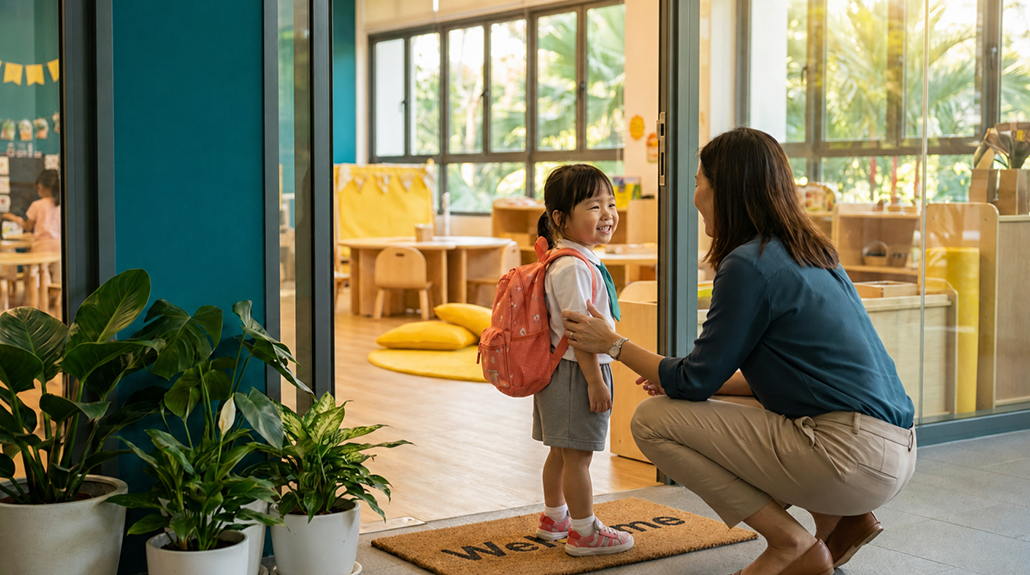
- Hand over with confidence. Greet the teacher warmly, help your child do the same, and then say goodbye clearly and cheerfully. Lingering at the door prolongs the emotional intensity for everyone.
- Keep your farewell phrase consistent. Saying the same thing each day, such as “I’ll pick you up after lunch, and I can’t wait to hear about your day,” gives children a reliable script to hold onto.
- Resist the urge to peek through the window. Most children settle within minutes of a parent leaving, and teachers are highly skilled at redirecting little ones into activities. Watching from outside often prolongs the child’s distress rather than easing it.
What to Expect in the Weeks That Follow
It’s worth setting realistic expectations: adjustment to pre-school is rarely a linear process. Many children have a wonderful first week and then hit a harder patch in week two or three, once the novelty wears off and the reality of the new routine sets in. This is perfectly normal and is not a sign that the school is wrong for your child.
During the adjustment period, prioritise rest and keep after-school time calm and low-key. Pre-schoolers who are processing lots of new information and social experiences will often be more tired and emotionally sensitive than usual. Extra cuddle time, quiet play at home, and a consistent bedtime routine all support the nervous system as it adapts to the new demands of school life.
Keep communication open with your child’s teachers. Most pre-schools in Singapore have regular channels for parent updates, whether through an app, a communication book, or daily check-ins at pick-up. Use these touchpoints to share anything relevant about your child’s mood or home environment, and to receive feedback on how they’re settling in at school.
How ChildFirst Supports Children Through the Transition
At ChildFirst, we understand that every child comes to pre-school with a unique set of experiences, strengths, and needs. That’s precisely why our curriculum is designed around a three-pronged approach that nurtures the whole child, not just academic readiness. Our Human Intelligence (HI) curriculum focuses on developing emotional resilience, social skills, and self-regulation, the very capacities that help children navigate transitions like starting pre-school with greater confidence and ease.
Alongside this, our Multiple Intelligences (MI) approach recognises that children learn and express themselves in different ways. Whether your child is a natural mover, a budding artist, a keen listener, or a curious problem-solver, our teachers are trained to identify and build on each child’s unique strengths from the very beginning. This means no child arrives on their first day and feels like they don’t belong, because the classroom is designed to welcome every kind of learner.
Our trilingual learning environment, which encompasses English, Chinese, and even coding as a form of language, means children are gently immersed in rich, meaningful communication from day one. And our Artificial Intelligence (AI) curriculum introduces technology in age-appropriate, playful ways, ensuring that the skills children develop today lay a genuine foundation for the world they will grow up in.
All ChildFirst centres are SPARK-certified and Healthy Pre-school accredited, reflecting our commitment to providing safe, nurturing, and high-quality environments where children don’t just attend school, they genuinely thrive.
Every Big Journey Starts With One Small Step
The first day of pre-school is a milestone that you and your child will both remember, not because it was perfect, but because it was the beginning of something wonderful. With thoughtful preparation, honest conversations, and a warm and capable school environment, children adapt to pre-school more readily than most parents expect. And more often than not, within a few weeks, the child who once clung to your leg at the door will be running in ahead of you, eager to see their friends and teachers.
Trust the process, trust your child, and trust yourself. You’ve already done the most important work by caring enough to prepare well.
Ready to Find the Right Pre-school for Your Child in Singapore?
Visit ChildFirst and see firsthand how our award-winning trilingual curriculum, caring teachers, and future-focused learning environment help every child begin their pre-school journey with confidence and joy.