Screen-Free Coding Activities for Young Children: Unplugged Learning Ideas
When most people hear the word “coding”, they picture a screen, a keyboard, and lines of text scrolling past. But here’s something that surprises many parents: some of the most powerful early coding experiences happen away from any device entirely. Screen-free coding activities, sometimes called “unplugged learning”, introduce young children to the building blocks of computational thinking through play, storytelling, movement, and creative problem-solving.
For pre-schoolers between the ages of two and six, the hands-on, physical nature of unplugged coding is not just a workaround for limited screen time; it is often the ideal starting point. Young children learn best through touch, movement, and social interaction, and these activities are designed to meet them exactly where they are. Whether your child loves building with blocks, acting out stories, or going on pretend treasure hunts, there is an unplugged coding activity that will spark their curiosity.
In this article, we explore what unplugged coding really means, why it matters for early childhood development, and share seven practical, tried-and-tested activities you can introduce at home or in the classroom today.
What Is Unplugged Coding and Why Does It Matter?
Unplugged coding refers to activities that teach the core concepts behind computer programming, things like sequences, loops, conditionals, and pattern recognition, without using any technology at all. The term was popularised by educators and researchers who recognised that the thinking skills behind coding are far more important than the tools used to express them. When a child learns to give precise, step-by-step instructions to a friend playing the role of a robot, they are practising the same logical reasoning that underlies all software development.
This approach is especially well-suited to pre-schoolers because it removes the barriers that screens can create for very young learners. There are no login screens, no fine motor skills required for typing, and no frustration when a programme does not load. Instead, the learning is immediate, physical, and deeply social. Children can make mistakes, laugh about them, and try again, which is, of course, exactly how real programmers work too.
Why Screen-Free Activities Are So Valuable for Pre-Schoolers
Beyond the practical advantage of reducing screen time, unplugged coding activities offer a rich cluster of developmental benefits that extend well beyond technology. Computational thinking, the ability to break a problem into smaller steps, spot patterns, and think logically, is a skill that helps children in mathematics, language, social situations, and creative endeavours throughout their entire lives.
Unplugged activities also naturally encourage collaboration. When children work together to navigate a maze or sequence a story, they are practising communication, turn-taking, and perspective-taking alongside their logical thinking. These are precisely the kinds of human skills that remain irreplaceable even as artificial intelligence becomes more prevalent in daily life. At ChildFirst, this balance between technology readiness and deeply human capabilities is central to the curriculum, you can read more about how this plays out in practice through our Human Intelligence (HI) curriculum, which nurtures creativity, empathy, and social awareness from the earliest years.
Additionally, many of these activities quietly build early literacy and numeracy skills. Sequencing a story requires an understanding of narrative structure. Counting steps in a maze reinforces number sense. Pattern activities lay the groundwork for algebraic thinking. The learning is genuinely multidimensional.
7 Engaging Screen-Free Coding Activities to Try
1. The Human Robot Game
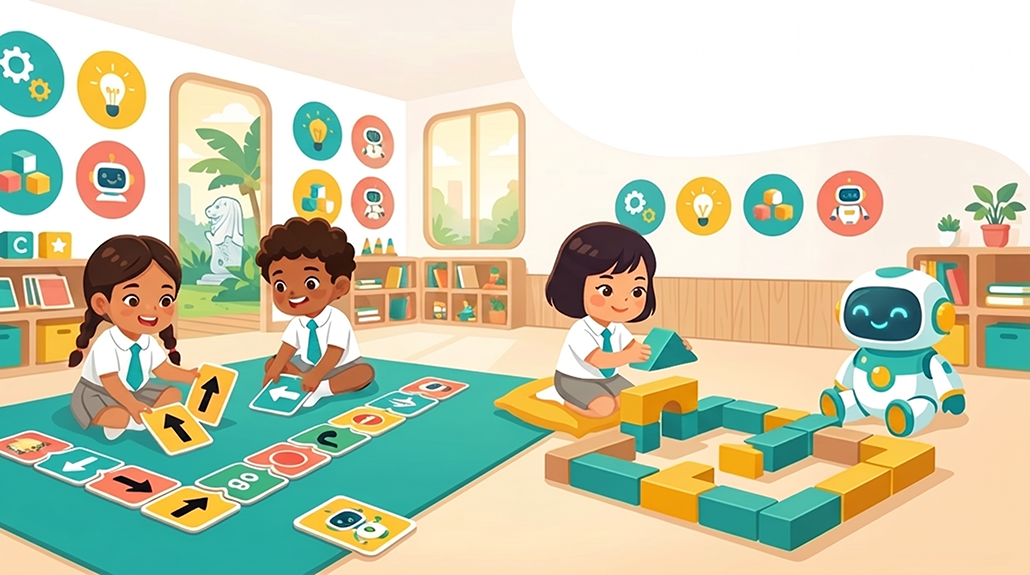
This is one of the most popular unplugged coding activities for a very good reason: it is hilarious, endlessly replayable, and brilliantly educational. One child plays the “programmer” and gives instructions to a friend or parent who plays the “robot”. The robot must follow only the exact instructions given, moving forward, turning left, picking up an object, without using any common sense to fill in the gaps. Children quickly discover that vague instructions lead to funny results, and that precision matters enormously.
Start simple: place a soft toy across the room and ask your child to guide you to it using only specific commands. As they grow more confident, you can introduce more complex challenges like picking up the toy and placing it in a box. This activity directly teaches the concept of algorithms, precise, ordered sets of instructions, in a way that sticks because it is experienced rather than explained.
2. Sequencing Stories with Picture Cards
Sequencing, putting events in the correct order, is one of the foundational concepts in coding. Before a computer can follow a programme, every step must be in exactly the right place. Picture cards bring this concept to life beautifully for young children. Draw or print a series of simple story cards (a seed being planted, watered, sprouting, and becoming a flower, for example) and ask your child to arrange them in order.
Once they have mastered a simple sequence, try introducing a deliberate mistake and asking them to debug it, another genuine programming concept. “The flower is before the seed, does that make sense? How would we fix it?” This kind of structured play lays groundwork that children will build on for years to come, and it connects naturally to early literacy as children learn to think about stories having a beginning, middle, and end.
3. Pattern Play with Everyday Objects
Recognising and creating patterns is at the heart of both mathematics and coding. The wonderful thing is that pattern activities require almost no preparation at all. Gather a collection of household objects, buttons, building blocks, coloured pasta, socks, and begin a simple pattern for your child to continue the sequence: red, blue, red, blue; big, small, big, small; circle, circle, triangle.
As children grow more confident, invite them to create their own patterns for you to continue, or challenge them to spot the “rule” in a pattern you have set without telling them what it is. This kind of pattern recognition thinking is directly transferable to coding, where programmers constantly look for repeating structures and loops that can simplify their work. It is also wonderfully low-stakes, there is no right or wrong, just exploration.
4. Coding Board Games
Several beautifully designed board games have been created specifically to introduce coding concepts to young children without a screen in sight. Games like Robot Turtles, Code Master, and Hopscotch (the physical version) use cards, tiles, and game pieces to teach sequencing, conditionals, and logical planning. They are designed to be played collaboratively or competitively, and most can be adapted for different ages and ability levels.
Even classic games like Snakes and Ladders or simple card games involve turn-taking, following rules, and strategic thinking, all skills that underpin computational reasoning. The key is to talk through the thinking as you play: “If you land on a snake, then you go down, that is an if-then rule, just like in coding!” Making the connection explicit, in simple language, helps children begin to see logical thinking as something they already do naturally.
5. Building Mazes and Navigating Them
Mazes are a wonderfully hands-on way to explore directions, decision-making, and problem-solving. Use masking tape on the floor, arrange cushions and books, or draw a simple grid on paper. Then ask your child to find a path from start to finish, either by physically walking through it or by drawing the route step by step. The challenge of navigating a maze requires children to plan ahead, consider alternatives, and backtrack when a path does not work, all genuine coding behaviours.
For an added layer of complexity, introduce the idea of writing down the route as a series of arrows or symbols before attempting to walk it. This turns the activity into a real algorithm-writing exercise. And when the route does not work as planned? That is debugging, a skill that even professional software engineers use every single day.
6. Binary Bead Bracelets
Binary code, the system of ones and zeroes that underpins all digital communication, sounds deeply technical, but it can be introduced to pre-schoolers in a genuinely accessible way using two colours of beads. Assign one colour to represent “0” and another to represent “1”, then show children how letters or simple patterns can be encoded using combinations of the two. Making a bracelet with their name encoded in binary is an activity that delights many young children precisely because it feels like a secret code.
This activity also develops fine motor skills as children thread the beads, making it a lovely dual-purpose craft project. You do not need to go into the mathematics of binary at this age, simply experiencing the concept that information can be represented in two states, and that sequences of those states carry meaning, is more than enough. The idea will resurface meaningfully when children encounter it again in later years.
7. Treasure Hunt Algorithms
A treasure hunt is already a favourite activity for young children, and with a small twist it becomes a powerful coding lesson. Instead of giving children clues to follow intuitively, write or draw the instructions as a step-by-step algorithm: “Walk three steps forward. Turn right. Walk to the blue cushion. Look underneath.” Ask children to follow the instructions exactly as written, then swap roles so they can write the algorithm for you to follow.
This activity brings together sequencing, directional language, and the critical idea that instructions must be both complete and precise. It is also a wonderful way to incorporate language development, particularly relevant in multilingual households or settings where children are learning to express direction and sequence in more than one language. Our Coding Meets Trilingual Learning approach at ChildFirst explores exactly this kind of rich connection between language and logical thinking.
Tips for Making Unplugged Coding Fun at Home
The most important thing to remember when introducing any of these activities is that the goal is curiosity, not correctness. Pre-schoolers who feel free to experiment, make mistakes, and try again are developing exactly the growth mindset that underpins both coding and lifelong learning. Here are a few practical tips to keep things enjoyable:
- Follow your child’s lead. If they want to extend an activity in an unexpected direction, go with it. That creative divergence is often where the deepest learning happens.
- Use the vocabulary naturally. Words like “algorithm”, “sequence”, “loop”, and “debug” are perfectly accessible to young children when they are introduced through experience rather than definition.
- Keep sessions short. Twenty minutes of engaged, playful activity is far more valuable than an hour of reluctant participation. Finish while the fun is still going.
- Celebrate mistakes out loud. Saying “Oh, that did not work, let’s figure out why!” models exactly the attitude you want your child to develop.
- Connect to their interests. A child who loves dinosaurs will engage far more enthusiastically with a dinosaur-themed sequencing activity than a generic one.
You do not need any special equipment or a background in technology to make these activities work. Most of what is needed is already in your home, and the most important ingredient, a willing, curious adult to play alongside, is already there too.
How Unplugged Learning Connects to Broader Development
It is worth stepping back to appreciate just how much ground these seemingly simple activities cover. A child who has spent time as a “human robot” has practised giving precise instructions, listening carefully, and thinking logically. A child who has built and navigated a maze has explored spatial reasoning, problem-solving, and perseverance. A child who has sequenced a story has developed narrative understanding, cause-and-effect thinking, and early literacy skills. None of this happens in isolation. It all weaves together into the kind of well-rounded intellectual foundation that prepares children for a complex future.
At ChildFirst, this holistic view of early childhood learning is embedded in every aspect of our curriculum. Our Artificial Intelligence (AI) curriculum introduces children to technology thoughtfully and progressively, while our Multiple Intelligences (MI) curriculum ensures that every child’s unique strengths, whether in language, music, spatial reasoning, or interpersonal skills, are recognised and nurtured. Unplugged coding activities fit naturally into this philosophy because they develop logical and creative thinking simultaneously, rather than treating them as separate concerns.
The children growing up today will enter a world shaped profoundly by artificial intelligence. But as educators and parents, our job is not simply to prepare them to use technology, it is to prepare them to think clearly, create boldly, and collaborate generously regardless of whatever tools the future holds. Unplugged coding activities, joyful and low-tech as they are, are a meaningful step in exactly that direction.
Getting Started: You Already Have Everything You Need
Screen-free coding is not a compromise or a substitute for the “real thing”, for pre-schoolers, it is the real thing. The logical thinking, creative problem-solving, and collaborative communication skills that these activities build are precisely what children need as their foundation, whether they go on to become programmers, artists, scientists, or something the world has not yet imagined. And the beautiful thing is that most of these activities cost nothing, require no special knowledge, and can be woven naturally into everyday play.
Start small: try the Human Robot Game after dinner this week. Pull out some colourful buttons and make a pattern together. Go on a treasure hunt with a hand-drawn map and step-by-step instructions. You may be surprised by how quickly your child picks up the underlying ideas, and how much fun you have along the way.
Want to See How We Bring Coding and Creativity Together for Your Child?
Visit ChildFirst to discover our unique trilingual curriculum, where AI readiness, human intelligence, and multiple intelligences come together to future-proof your child, from the very start.