How to Identify Your Child’s Dominant Intelligence: A Parent’s Observation Guide
Every parent has had that moment, watching their child lose themselves completely in a puzzle, or listening to them hum a tune they heard just once and already have memorised. It is tempting to chalk it up to a phase, but what if it is actually a window into how your child’s mind works best?
Dr. Howard Gardner’s theory of Multiple Intelligences suggests that intelligence is not a single, fixed trait measured by a test score. Instead, every child has a unique profile of strengths spanning eight distinct areas, from language and music to movement and interpersonal skills. Identifying your child’s dominant intelligence does not mean putting them in a box; it means giving yourself a map to understand how they learn, play, and connect with the world around them.
This guide is designed for parents of pre-schoolers who want to become more intentional observers of their child’s natural tendencies. You do not need any specialist training, just a little patience, an open mind, and the practical signposts laid out below.
What Are Multiple Intelligences?
First introduced by Harvard developmental psychologist Dr. Howard Gardner in his 1983 book Frames of Mind, the theory of Multiple Intelligences proposed that human cognitive ability is far broader than traditional IQ measures suggest. Rather than a single general intelligence, Gardner identified distinct modes of processing information, each representing a legitimate form of intellectual strength. Over the decades, this framework has been widely adopted in progressive early childhood education because it validates the enormous diversity in how young children think and learn.
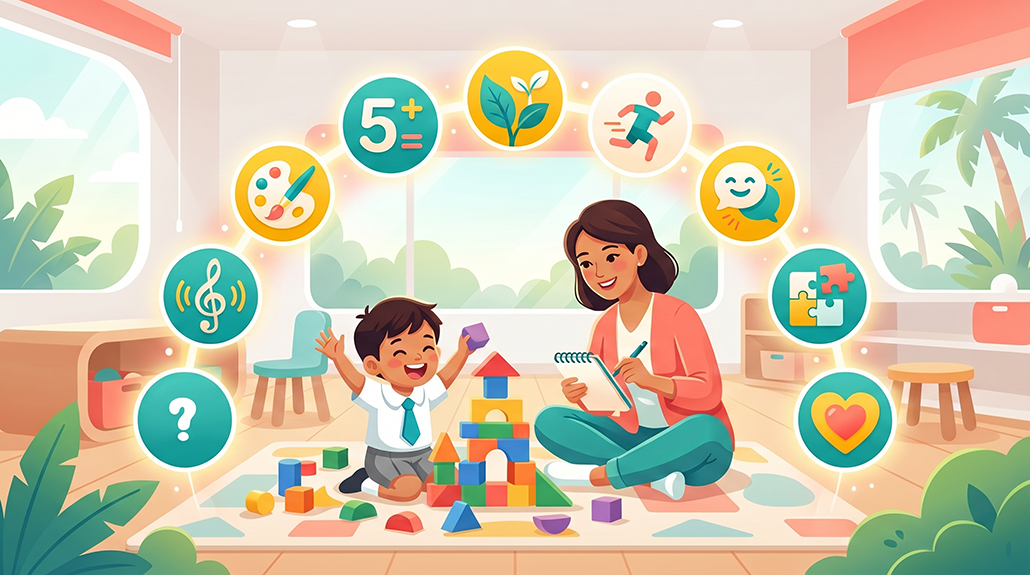
The eight intelligences Gardner identified are: Linguistic, Logical-Mathematical, Spatial, Musical, Bodily-Kinesthetic, Interpersonal, Intrapersonal, and Naturalist. Most people have a blend of several, but children often show a noticeably strong pull towards one or two areas from a very early age. Recognising this early allows parents and educators to provide environments where that natural strength can flourish, and where other intelligences can be gently developed alongside it.
Why Identifying Intelligence Early Matters
The pre-school years, roughly from 18 months to six years old, are a period of explosive brain development. Neural connections form at an astonishing rate during this window, and the experiences children have during these years lay the groundwork for how they approach learning for the rest of their lives. This is precisely why understanding your child’s dominant intelligence during this stage can be so powerful.
When children are taught and engaged in ways that align with their natural strengths, they develop confidence, curiosity, and intrinsic motivation. A child who is highly Bodily-Kinesthetic, for example, will thrive with hands-on activities but may disengage quickly from purely verbal instruction. Without an awareness of this preference, parents and teachers can sometimes misread restlessness or inattention as a behavioural issue, when it is really just a learning style mismatch.
Beyond confidence, early identification also supports children in discovering their unique niche, the intersection of talent, passion, and purpose that can guide their personal and academic development. At ChildFirst, this is a cornerstone of the Multiple Intelligences curriculum, which is designed to help every child discover and develop their individual strengths from the earliest years.
The Eight Intelligences Explained for Parents
Here is a practical breakdown of each intelligence, written specifically for parents observing young children at home and at play:
1. Linguistic Intelligence (Word Smart)
Children with strong linguistic intelligence love words, telling stories, asking endless questions, making up rhymes, or reciting phrases from books and songs with impressive accuracy. They often learn to read early, enjoy being read to, and tend to express their feelings and ideas through language with unusual clarity for their age.
2. Logical-Mathematical Intelligence (Number Smart)
These children are drawn to patterns, sequences, and cause-and-effect relationships. You might notice them sorting toys by colour or size without being asked, asking “why” relentlessly, or showing a fascination with counting, categorising, or figuring out how things work. They often enjoy simple puzzles and strategy-based games from a very young age.
3. Spatial Intelligence (Picture Smart)
Spatially gifted children are highly visual. They may spend long stretches building with blocks, drawing detailed pictures, or navigating spaces confidently. They often think in images and may be able to mentally rotate objects or remember the layout of a place they have only visited once.
4. Musical Intelligence (Music Smart)
If your child hums while playing, picks up melodies quickly, taps rhythms on the table, or becomes deeply moved by music, emotionally calm or energised depending on the song, they may have a strong musical intelligence. These children are highly attuned to sound, tone, rhythm, and pitch in ways that go beyond typical enjoyment.
5. Bodily-Kinesthetic Intelligence (Body Smart)
Children with this strength learn through movement and physical experience. They are often highly coordinated, love dancing, climbing, or building things with their hands, and may struggle to sit still for long periods. Importantly, they process information best when it is linked to physical action rather than passive listening.
6. Interpersonal Intelligence (People Smart)
These children seem naturally attuned to the emotions and moods of others. They tend to be sociable, empathetic, and good at resolving conflicts in their peer group. They thrive in collaborative play, often take on leadership roles naturally, and genuinely enjoy being around other children and adults.
7. Intrapersonal Intelligence (Self Smart)
A child with strong intrapersonal intelligence has a remarkable level of self-awareness for their age. They may show a clear sense of their own preferences and feelings, prefer to process experiences quietly, enjoy independent play, and display a strong sense of personal values and goals, even in early childhood.
8. Naturalist Intelligence (Nature Smart)
These children are fascinated by the natural world, animals, plants, weather, seasons, and living things in general. They notice details outdoors that others walk past, love collecting leaves or rocks, and may show a natural ability to categorise and name different species or natural phenomena.
Everyday Observation Tips: What to Watch For at Home
You do not need to conduct formal assessments to get a sense of your child’s dominant intelligence. The clues are already present in their daily play, conversations, and behaviours. The key is to observe without an agenda, let your child lead, and pay attention to where their energy, focus, and joy consistently land.
Here are some practical things to observe across different home settings:
- During free play: What does your child choose to do when given completely unstructured time? This is often the clearest indicator of natural preference.
- When frustrated or upset: Do they talk it out (Linguistic), go quiet and reflect (Intrapersonal), seek out a friend or sibling (Interpersonal), or move their body to self-regulate (Bodily-Kinesthetic)?
- During storytime: Are they focused on the words and narrative, the illustrations, the rhythm of the language, or asking questions about characters’ feelings?
- In outdoor spaces: Do they gravitate towards other children, towards physical challenges like climbing frames, or towards examining insects and plants?
- When learning something new: Do they prefer to watch first, jump straight in physically, ask lots of questions, or want to draw it out?
Keep a simple notebook over a few weeks and jot down moments that stand out. Patterns will begin to emerge naturally, and you will start to see your child’s intelligence profile taking shape. Remember, most children will show strengths in more than one area. The goal is to notice where the energy is most consistent and most joyful.
What to Do Once You Identify Your Child’s Strengths
Once you have a clearer picture of where your child’s natural strengths lie, the next step is to create more opportunities for those strengths to shine, while also gently exposing them to areas where they are less naturally inclined. This balanced approach is what leads to well-rounded development rather than a narrow focus on a single talent.
For a linguistically strong child, enriching their world with books in multiple languages can deepen both their love of words and their cognitive flexibility. This is where a trilingual environment becomes particularly powerful. Learning to express ideas in more than one language exercises the linguistic intelligence from multiple angles, building vocabulary, comprehension, and cultural awareness simultaneously. ChildFirst’s approach to nurturing English proficiency in a trilingual environment and its Chinese pre-school and trilingual learning programme are designed with exactly this kind of layered enrichment in mind.
For a child with strong logical-mathematical or spatial tendencies, introducing age-appropriate coding and problem-solving experiences early can be transformative. These children often take to computational thinking intuitively, and structured exposure gives them a constructive outlet for their analytical nature. ChildFirst’s coding meets trilingual learning programme offers a unique space where logic and language development go hand in hand.
Most importantly, avoid the temptation to over-schedule or over-direct. Young children learn best through play, exploration, and genuine curiosity. Your role as a parent is to open doors, and the right child will walk through the right one, in their own time.
How ChildFirst Supports Every Type of Learner
Understanding your child’s dominant intelligence is only the beginning. The real magic happens when that understanding is met by an educational environment specifically designed to nurture it. ChildFirst’s curriculum is built around the belief that every child is gifted, and the role of education is to find out how.
Through its unique three-pronged approach combining Artificial Intelligence (AI), Human Intelligence (HI), and Multiple Intelligences (MI), ChildFirst goes beyond traditional academic preparation. The MI component ensures that children across all eight intelligence types are engaged meaningfully, whether they are a budding musician, a natural leader, a tireless explorer, or a quietly reflective thinker. Meanwhile, the HI focus nurtures the deeply human skills (creativity, empathy, resilience, and critical thinking) that no algorithm can replicate. And the AI curriculum ensures that even the youngest learners develop fluency with the technology that will shape their futures.
This integrated approach means that whether your child is “word smart,” “body smart,” or “nature smart,” there is a place at ChildFirst where they are genuinely seen, understood, and challenged to grow.
Helping Your Child Shine in Their Own Way
Every child arrives in the world with a unique constellation of strengths. The role of a parent (and of great early childhood education) is not to shape children into a single mould, but to help them discover who they already are and give them the tools to build on it.
By observing your child with curiosity and intention, you can begin to see the patterns that point towards their dominant intelligence. And once you see it, you can nurture it through the activities you choose at home, the conversations you have, and the learning environment you place them in. That small shift in perspective can make an enormous difference in how confidently and joyfully your child engages with the world.
Want to See How We Nurture Every Child’s Unique Intelligence?
Visit ChildFirst to experience our one-of-a-kind trilingual curriculum that combines Multiple Intelligences, Human Intelligence, and AI learning, giving every pre-schooler the environment they need to truly thrive.